
From Strength to Weakness: India’s Turmeric Shift
More land, more yield, more production—yet declining control. Discover how India’s traditional turmeric model is failing modern global buyers and what exporters must change immediately.
Athish Ravikanth
4/28/20266 min read
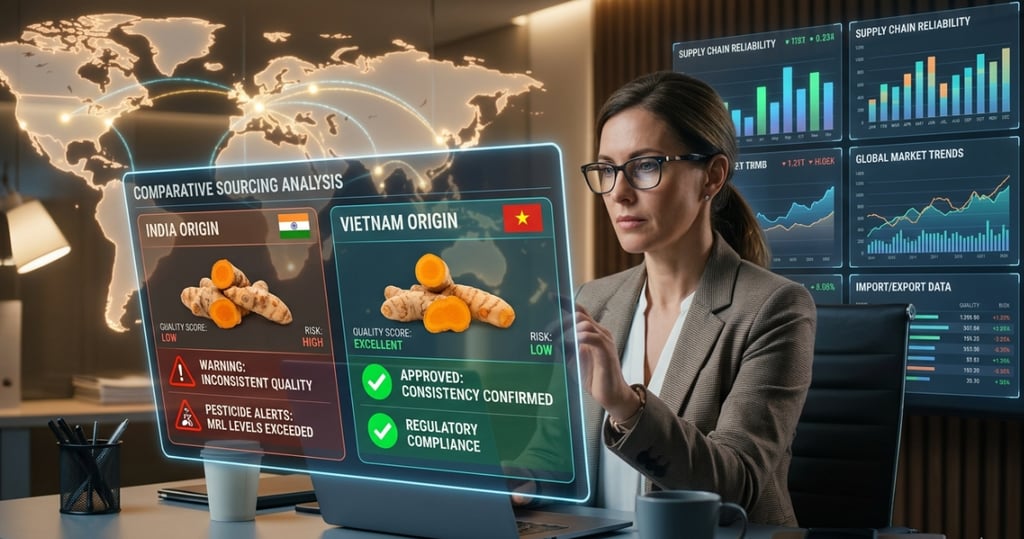
If you’re in the turmeric business, a farmer, trader, exporter, or an entrepreneur exploring India or Vietnam, ignoring this shift will cost you money. Not someday. Soon.
On paper, India should dominate the global turmeric trade. It has the land, the yield, the research, and even the premium varieties. But global trade doesn’t reward potential. It rewards control.
And that’s where things start to get uncomfortable.
Because while India is busy producing more, Vietnam is quietly positioning itself better.
This is not a volume battle. This is a strategy gap.
India vs Vietnam: The Turmeric Battle No One's Talking About
1. Cultivation area
India cultivates turmeric on approximately 305,000+ hectares. Let me share few link for your reference
Vietnam cultivates around 50,000 hectares.
👉 Simple math: India has 6x more land under turmeric cultivation.
There's more to this story than just land and production numbers — let's dig deeper.
2. Curcumin Content: The “Quality Myth” Needs Correction
India Turmeric primarily contains 3–8% curcumin, depending on the growing season, variety, and processing.
Vietnam's government portal states that Vietnamese turmeric has good quality with a high curcumin content of 3–5%. This figure is consistently repeated across Vietnamese government communications and trade association (VPSA) reports as the standard range for commercially grown Vietnamese turmeric.
Let me share short comparison below: Curcumin Range → India: 2–6.6% | Vietnam: 3–5%
Premium / High-Curcumin Varieties → India: 6–12% (Lakadong, Alleppey, Edapalayam) | Vietnam: No equivalent documented
Official Minimum Standard → India: No single national threshold | Vietnam: ≥5% (Vietnamese Pharmacopoeia)
Best Data Sources → India: ICAR, TNAU, NIH/NCBI | Vietnam: Vietnamese Pharmacopoeia, VNUA, HPLC studies
Peer-Reviewed Studies → India: Hundreds | Vietnam: A handful (growing field)
India also has high-curcumin turmeric but India doesn’t supply it consistently at scale. That’s the actual gap.
However the story doesn’t end here, there is more important to come in this article.
3. Yield Per Acre: India is Ahead (Again)
In India, the average yield of fresh green turmeric is approximately 8–10 tonnes (8,000–10,000 kg) per acre. Under highly favorable conditions, with proper management, improved varieties, and irrigation, this yield can increase up to 12–18 tonnes (12,000–18,000 kg) per acre. Reference
No Vietnamese government agency publishes a standalone "turmeric yield per hectare" statistic in a publicly accessible report. The figures below are derived from trade platform estimates.
VinaSources reports that in 2024, Vietnam's total turmeric harvest reached approximately 172,000 metric tonnes from over 50,000 hectares of cultivation. VinaSources
Derived yield: 172,000 MT ÷ 50,000 ha = ~3,440 kg/ha (~1,392 kg/acre) of fresh rhizome. This is a derived figure, not a directly stated government statistic.
So India wins in land, yield, and even premium quality, then why are buyers still moving away?
Note: Yield figures may not be directly comparable due to differences in measurement basis (fresh vs processed estimates)
4. Specification
Both countries largely align with global benchmarks like Codex Alimentarius Commission.
India:
FSSAI mandates the following for turmeric (whole and powder): minimum curcumin content of 2% by weight, maximum moisture content of 10%, total ash not more than 9% by weight, and acid insoluble ash not exceeding 1.5%. Extraneous matter must not exceed 2%.
For export-quality turmeric powder, buyers should look for an ASTA color value of 100–120 or higher. Alleppey turmeric from Kerala is specifically prized for its curcumin content of 5–6.5%, making it the top choice for nutraceutical applications.
In short:
Governed by Food Safety and Standards Authority of India (FSSAI)
Strong export ecosystem via Spices Board, APEDA
ASTA color standards widely followed
Vietnam:
The Vietnamese Ministry of Health sets a minimum curcuminoid content of ≥5% for medicinal-grade turmeric under the Vietnamese Pharmacopoeia. For food-grade export, Vietnam applies TCVN (Vietnam National Standards, issued by STAMEQ/Ministry of Science and Technology) and international standards like ISO 22000 and HACCP, with no single publicly accessible TCVN document dedicated exclusively to turmeric specifications.
In Short:
Uses TCVN standards + Vietnamese Pharmacopoeia
Exporters heavily focused on:
5. Import Tariffs: No Real Advantage
Across major markets like:
USA
EU
Japan
👉 Import duties are almost identical for both India and Vietnam.
(China is a minor exception where Vietnam has some advantage.)
So again—tariffs are not the reason.
Now the Real Question
Why is Vietnam’s turmeric export growing faster?
This is where things get uncomfortable for India.
The Two Brutal Truths
1. MRL Problem (Pesticide Residue)
This is the biggest silent killer of Indian turmeric exports.
India is unable to supply more than 10% of the global requirement of turmeric with higher than 5% curcumin — a key demand from pharmaceutical and nutraceutical buyers globally. Other acknowledged weaknesses include high use of pesticides and insecticides, lack of market knowledge, and limited R&D and innovative products. India must evolve from being just a raw turmeric supplier by innovating, ensuring quality, and adopting sustainable practices. This column was written by the authors of the ICRIER report — Dr. Arpita Mukherjee and Souvik Dutta.
In 2024, India faced over 1,200 spice alerts via the EU's RASFF portal, with turmeric accounting for approximately 15% of these alerts. The EU's MRLs allow less than 0.01 mg/kg for over 400 pesticides — a standard that many Indian small holder farmers struggle to meet due to use of outdated pesticides without precise guidance. Reference
India's pesticide consumption per hectare of gross cropped area was 0.322 kg/ha in 2017–18, declining slightly to 0.289 kg/ha in 2021–22. However, Telangana which is one of India's largest turmeric-producing states recorded 0.613 kg/ha, more than double the national average.
FSSAI is yet to recommend MRLs for turmeric as a commodity. The EU MRL database has entries for 491 pesticides for turmeric; Canada has set MRLs for 48 pesticides in turmeric root; the Codex has set MRLs for 31 pesticides in spices. India's farmers therefore apply pesticides on turmeric with no crop-specific MRL guidance from the relevant department which increases the probability of EU/US MRL violations structurally.
Whereas Vietnam's turmeric is predominantly grown by ethnic minority communities in remote Central Highlands have long cultivated turmeric and other spices including ginger as part of an integrated, traditional agroforestry system alongside coffee, fruits, and forest trees.
Their farming culture is rooted in animism and a deep connection to nature, with historically low chemical input use. The Rainforest Alliance's 2023–2024 IPM project, when introduced to this community, found that farmers had limited prior pesticide use and needed training primarily on composting, fertilization, and soil health, not on reducing excess pesticide use, which was not yet a widespread practice in their traditional system.
In short:
EU allows <0.01 mg/kg for many pesticides
There are 400+ pesticide limits buyers test for
Now look at India:
No clear turmeric-specific MRL guidance domestically
Farmers use pesticides based on guesswork or local advice
Result: Shipment rejections
👉 In 2024:
1200+ spice alerts in EU
~15% linked to turmeric
One rejected shipment =
❌ Loss
❌ Reputation damage
❌ Possible blacklisting
Why Vietnam doesn’t face this as much:
This is not because they are more advanced.
It’s because they are less intensive.
Grown by ethnic communities
Traditional farming
Low chemical input
👉 Result:
Naturally low pesticide residue
Fewer export rejections
2. India’s Broken Supply Chain
The ICRIER report explicitly documents that over 57.6% of Indian Farmer Producer Organizations rely on middlemen and agents to sell their turmeric produce, and only 36.4% use regulated markets, APMC, or e-NAM platforms. Furthermore, over 50% of companies sourcing turmeric rely on mandi agents, commission agents, and local traders with back-end traceability to the farm being severely limited. Reference
India’s chain looks like this:
Farmer → Village trader → Mandi agent → Aggregator → Processor → Exporter
Each layer:
Adds cost
Reduces traceability
Complicates quality control
This multi-layer chain is structurally embedded in India's turmeric supply chain and significantly inflates the final FOB price.
Whereas Vietnam's turmeric supply chain, being smaller and newer, has fewer intermediary layers between farm and export processor.
In Vietnam turmeric is collected directly from farmers, washed, sliced by machine, dehydrated, and ground in-house in a streamlined, low-overhead process with minimal intermediaries between the farmer and the processing facility. Their factory mainly operates with HACCP, GMP & ISO 22000 certification but with a simpler, leaner cost structure than large Indian processing hubs.
Conclusion
India is not losing the turmeric market because it lacks production capacity.
It is losing because it lacks control over quality, consistency, and supply chain.
When farmers operate without clear MRL guidance, when exporters depend on fragmented sourcing, and when pricing is driven by mandis instead of market strategy, the result is predictable:
Inconsistent product. Unstable pricing. Eroding buyer trust.
Vietnam is not winning because it is superior. It is winning because it is simpler, more controlled, and easier for buyers to work with.
And in global trade, that’s enough.
Because at the end of the day, buyers don’t pay for how much you produce. They pay for how reliably you deliver.
#turmeric #indianturmeric #vietnamturmeric #spicestrade #agriculturebusiness #agriexports #exportbusiness #globaltrade #supplychain #commodities #spicesexport #curcumin #foodexport #agriinnovation #farmtotable #exportstrategy #internationaltrade #agribusiness #marketinsights #tradingbusiness
TRAVEL & TRADE
Bangalore, India